Showing posts with label writings. Show all posts

Monday, September 26, 2011

Chua Mia Tee and Bayu Utomo Radjikin

Workers in the Canteen by Chua Mia Tee 1974

Oil on canvas, 89 x 126cm


Lang Kacang by Bayu Utomo Radjikin 1991

Mixed media, 141 x 104 x 120cm

---

How did the artists address the above social concerns/issues through their work?

Chua Mia Tee has addressed his idea through a realistic and straightforward style. He believes that art must reflect real life and that viewers of his work and art must be able to understand what the artist is trying to express and his ideas. He has painted in the style of realism so that people are able to understand his intentions and ideas easily.

He has chosen a clear subject matter which can be easily related by local Singaporeans, thus being able to understand the issue. Also, he has made use of the exaggerated lighting, which focuses on the first bench of workers eating. He has also made use of lines, thought the arrangement of the benches and tables. These lines bring viewers' eyes slowly through the painting from the foreground to the background. The use of light and lines are done so to put focus on the workers eating.

Chua Mia Tee often uses photographic aid, so that he can arrange his subject matter and compositions. He makes use of such composition, which enhances and improves his expression of his concern and idea of work.

Bayu Utomo, on the other hand, has made use of the different materials to express his idea of urbanisation destroying traditional cultures. He has chosen to use metal chains that are chained to the sculpture, to represent the pull of the advancing technological development, and that these traditional tribes are unable to run away from the fact that urbanisation is able to erode their cultures. The feathers and the distorted expression represent the struggles of these tribal communities. The contorted leg of the sculpture also shows that it is rooted to the ground and unable to run away from the clutches of urbanisation, which are represented by the metal chains chained to the sculpture. The sculpture makes the viewers feel the pull of urbanisation and that tribal communities are changing and suffering. He made use of a more symbolic style of expressing his concern.

Lucia Hartini

What social conerns are intended in Lucia Hartini's work? Discuss with reference to "Spying Eyes" and another named work by Lucia Hartini.

Lucia Hartini's works represents the struggles and fears of the Indonesian society that she lives in. The traditional culture in Indonesia views women as the weaker gender and are only able to be homemakers, housewives who take care of children, cook and do housework at home. There are also very few female artists in the Indonesian society as compared to male artists.
She has expressed her struggles through her works like Spying Eyes and Sri Kandi. Spying Eye depicts the society's traditional view on women, as represented by the eyes around the brick walls, staring at the female figure. The female figure could represent Lucia Hartini, whereby she is in a foetal position, floating above the ground. This shows that Hartini feels very vulnerable, weak and passive about the society's inequality and unfair, unequal views on the different genders. She feels constrained by such a view as a female artist in Indonesia. She has an obssession with eyes and is frightened by eyes as the eyes represent views of others in the society. She feels that someone is always watching her and judging what she does and thus, she painted the eyes to show how others are staring at her, judging her. The cracked brick walls also represent her struggles in the society as she did not like people viewing her in the traditional way and to judge her. She is trying to overcome this obstacle and be brave to overcome what others view women in society and her.
Sri Kandi is also a sequel to Spying Eyes as in Sri Kandi, she painted her emotions and her confidence and determination to confront all judgments of others. "Sri Kandi" is a Javanese traditional puppet that represents a Mahabrata epic, warrior women in the past. Hartini depicts herself as "Sri Kandi" to show that she is bold and brave, and has changed from someone who is powerless, vulnerable to someone who can overcome her struggles and problems. Sri Kandi represents Lucia Hartini. Also, the female figure which represents Hartini in the painting is wearing blue cloth. Blue cloth represents that she is strong as the female warriors in the past wore blue. Her body language in Sri Kandi also represents how strong-willed she has become and that she is determined to overcome others' judgments. The blue drapery from her dress also extends out and is lying on the brick walls, showing a sense of stability that Hartini feels towards her struggles in the past. She no longer feels constrained by the society's traditional judgments. The zig-zagged brick walls in the painting also extended out into the background of the painting, straightening out. The zig-zagged walls extended out as a straight brick wall, and might represent how she feels that things have straightened out and she is brave, no longer worried about others' judgments.

Lucia Hartini has explored dreams and imagination as she sought to discover herself through her works. Why did she create dream-like imagery and do you think she has been effective in using dreams as part of her works? Discuss with reference to her named works.

Lucia Hartini created dream-like imageries to express and carry her personal and social messages as Indonesia had a traditional culture that found straightforward critical and confessional discourse unacceptable. Therefore, Hartini could not paint realistic scenes of the society and could only express her struggles in the society through dream-like imageries and by using allegorical or symbol-laden styles. This is so as to not subject to further criticism.
For example, in Nuclear Explosion in a Wok III, Hartini expressed her anger with the society through the nuclear explosion, which is also in tones of reds and orange. She has been effective in her works as she is able to carry her messages and ideas through art in a restrained manner as she could not be very direct in the society.
She also created dream-like imageries to express her ideas indirectly. Her dream-like imageries, which are placing subject matters with no relations, and has a setting that is not seen in real-life context but can only be imagined or appear in dreams and fantasies. She also painted in highly academic, accurate brushstrokes, producing realistic forms of humans, cosmo and scenes.
In Sri Kandi, she made us of symbols and colours to express her feelings and emotions. The blue dress represented how she felt brave, bold and strong to overcome others' views and judgments that are traditional but unfair to the different gender, as blue was the colour that female warriors wore in the past. She also depicted herself as "Sri Kandi", a famous "women warrior" of South East Asia, representing how courageous she has become. Hartini has been effective in using dreams as part of her works as she made use of symbols to represent a meaning, emotion that she feels and her struggles in the society. She also made use of dream-like imageries by painting cosmos that has relation to nature elements as she grew up in a natural and carefree environment, and she yearns to return to that environment where no one would judge her in this current society.

Sunday, September 25, 2011

Don't Forget


6 x A4

Water colour, pen (2011)

I started off doing my coursework, following the theme of relationship between people who are important to me and treasuring time with friends/family, because I feel that people around me play a big role in my life and I wanted to do something important to me for my coursework. I have chosen to present my final work in a calendar format, featuring 6 important people in my life. They are my father, Shiyin, Chermaine, Enning, Lynn and Weiping. I chose to present it in a 2012 calendar as I wanted use it to act as a reminder for myself to spend time and maintain our relationships as relationships need time to foster and are based on what we do together, or how we spend time together. Also, I've always liked making art that is practical and usable in our lives, because I think that makes the art-making process more meaningful.

After that, I moved on to taking photographs of scenes where my friend/father and me are together, spending time and doing something together. I wanted to place these scenes into the calendar as I feel that to maintain relationships with other people, we have to spend time together and at the same time do something together to improve our relationship.

And then I proceeded to drawing these scenes out in pencil, pen and water colour. I chose water colour and my main medium and used pen to enhance the lines of the subject matter in the painting. The reason why I chose water colour was because I thought water colour is smoother, natural and less harsh as compared to other mediums like oil paint, acrylic and colour pencil. I thought the colours of water colour painting would be able to bring out the idea of the scene more. Also, I wanted to explore water colour painting because I was inspired by Dallas Clayton. I saw his works here and seeing his works made me want to try out water colour. Also, Dawn Tan! I found her blog a year ago and have always read her blog since then. I've always liked how she used water colour for her food paintings. You can see my post about her here.

After which, I did around 3/4 compositions for each scene/page of the calendar and started on my final. I painted all the scenes on A4 water colour paper and scanned them in to put it into my calendar template! I had 2 layouts, for the portrait and landscape paintings, you can see them here. I also added in birthdates of these people into the calendar, because we most often spend time with a person during his/her birthday celebrations and I think that birthday celebrations always bring people together. Also, birthdates are more personal and representative of a person.

Throughout the entire coursework process, I was rather slow and I thought I did too little research drawings. I could have drawn more and explored more into the scenes and elements of each painting. But seeing the final work I've came up with, it feels very rewarding and I'm proud of my work because I know I did put in hard work and tried my best to make it my best and final work in Nanyang AEP! There were definitely times when I feel annoyed with my works but at the end, I still try my best because I loved art and loved what I was doing.

Also, I've definitely improved my water colour painting & pen drawing skills! I still like these 2 mediums because I'm able to control them well :-) I think being able to paint is amazing and it is also rather therapeutic? Whenever I paint a particular scene, it makes me think more about the person, and my relationship with him/her. This work is pretty personal because I felt a lot for it when I painted the paintings. Another thing I've gained/learnt through this coursework is the importance of friendship! I am so thankful for my friends, Val, Cher, Sy, Clare, who've helped me through the coursework process, gave me opinions, ideas and motivated me to continue my work. They also helped me a lot with my 8 prep boards on the submission day!!! I was so stressed/nervous/tired I couldn't really think properly then (thanks to Linhui too!)

Saturday, September 24, 2011

Invisible Relationships

Group Photo Series - Qiu Zhi Jie, Five Revolutionary Seconds - Sam Taylor-Wood


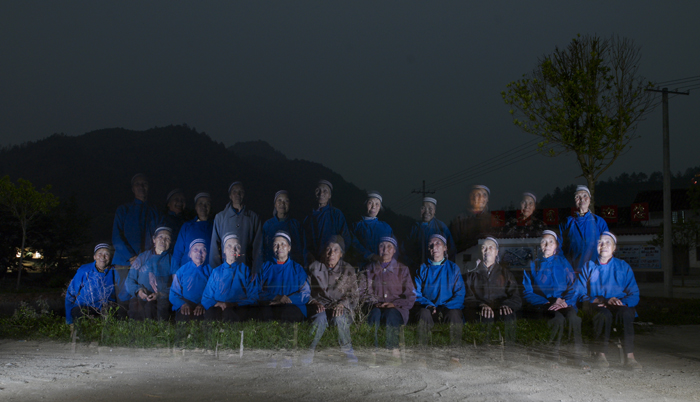
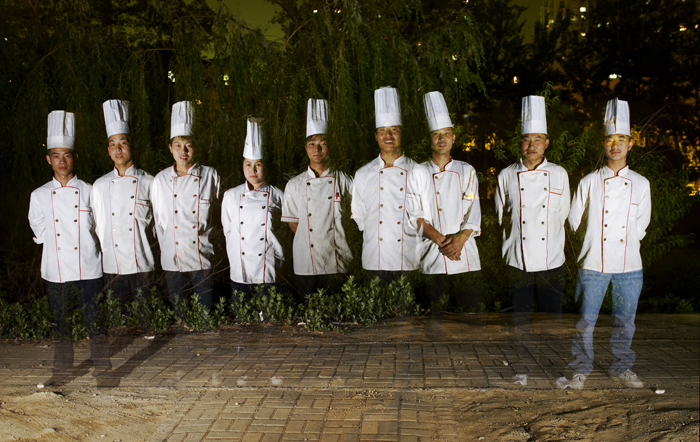
When I first saw Qiu's group photo series at the gallery, I wondered, "How did he take photographs like that? What was the meaning of the photographs? Why did he take those photographs? What was he trying to tell people?" The group photo series consists of 13 photographs in total. The photographs had dark backgrounds while the people seen in the photos were hit with light. The people looked like "ghostly figures", slightly translucent. The work was produced between 2006 and 2007 in different parts of China.

In Qiu's group photo series, it is also like a drama. In the video installation, it can be seen that, firstly, in the dark, a man walks to the front of the camera lens; stand up, the light lights on his body. He walks away. Then, the second person walks to the front of the camera lens too, standing beside the man who had just left. The light lights on his body. He walks away. One by one, the people walk onto the stage, stay for a while, and walk back. In the video, it shows a lonely person, appearing on the stage. Sometimes the man who is supposed to leave the stage may forget to leave. And sometimes, the man who is supposed to go onto the stage may not have arrived. Well the reason is, these people have received light and their form is kept, which becomes a group photo. Then, the group photo becomes a 'drama'. In the eyes of the audience, things that had happened in the same scene but in the different time are reconstructed in the same time and same space. Everyone in the photograph is related to each other. In the photo, the people appear together in the same group photo. Whereas in the video, they are actually very lonely themselves.

On the wall text next to Qiu's group photo series at the gallery, it was written that events happen at different times, but when seeing the photograph, they are relocated to the same time-space. The static photograph becomes a set of play an the relationship between one and the other is thus developed. Individuals appear as a group in the photographs ('we'), while the video shows them as solitary ('I'). In the photographs, there are collective narratives, names and identities of the individuals, but the video separates these identification.

In the video, the people are on of the "I-s", an individual. In the photograph, they are interpreted as "we", a group of people. They are a collective of narrative, a collective name and identity in the photography. However, the identity has been peeled off by the video. In the video, people return to the place which has no relation to others, people "escape" from the collective position. They are always neglecting the "I" but being aware of the "we". And when they think of "I", they often forget that "I" actually belongs to "we", a group of people. People are used to ignoring "I" when they consider the "we" and when they think about the "I" they forget that individuals unconsciously belong to a group.

The group photo series highlights the invisible relationship between people and it tells me that it takes up "I-s" to make up a "we".


Five Revolutionary Seconds XI (1997)
Chromogenic color print (28 x 298" overall)

Next, let me move on to another contemporary artist's work, Five Revolutionary Seconds by Sam Taylor-Wood. The reason why the art work is named as Five Revolutionary Seconds, is because it combines elements of the still and moving image and it is taken by a rotating camera that turns nearly 360 degrees in five seconds. The work records the motions and gestures of six actors and friends enlisted by Sam Taylor-Wood.

In the photograph, each character seems to be lost in his or her own reality. They look bored. Everyone in the photograph seems to be in their own world, thinking about their own problems in life. It can be told from their facial expressions and their body language. They are only thinking about themselves alone, and ignoring the people around them. They are all withdrawn, thus unaware of the people around them, the things happening near to them and their surroundings. They are acting as individuals in the photograph. In my opinion, I feel that they are selfish people who only care for themselves and not realizing that others are also in the same state as they are.

From Qiu's group photo series, it shows that certain people has neglected the importance of "I-s" and themselves. They have forgotten the fact that the individuals are very important to a group as they belong to it.

On the other hand, from Sam Taylor-Wood's photographs, it tells me how the other group of people who are selfish. They only have thoughts for themselves and their problems. They live in the world of their own and only think about their own problems in life. They have not realized that everyone around them, near to them, is exactly like themselves. They only bother about themselves without understand others around them.

I feel that both of the contemporary artists' photographs show the different types of "invisible relationship" between people, however, in a different and unique manner.

Photo credits:
http://www.moma.org/interactives/exhibitions/1998/newphoto14/sam_taylor_wood.html

Happy World - Ik-Joong Kang (2008)

Mixed media on wood, 485 x 485cm

Detail from Happy World by Ik-Joon Kang

Happy World: 48 x 48 pieces of 3" x 3" glazed wooden tiles with either paint on them or objects stuck to it. The objects included toys like "beyblades", rubber ducks, yo-yos, guns and trucks. There were also pieces of mirrors, calculators, baseballs, can openers, spoons and even an old Canon camera. I liked the Canon camera, particularly. It was the only camera stuck onto the wooden tiles.

The artwork was named "Happy World". I thought that every day objects stuck onto the tiles looked interesting and fun. Toys, utensils, things that we would use everyday. Happy World shows everyday and simple objects. Most of them were toys that we or the previous generation tend to play when we were young. Hence, these objects give the artwork a happy feeling, making us remebmber the happy times during our childhood.

The artwork is filled with colours, yet, they are not clashing. Therefore, it does not spoil the artwork. Also, this artwork probably wants to tell us that simplicity can also bring happiness to one, and that we should be contented but not be greedy instead.

I really liked how Kang placed all the colourful objects together, without letting the colours clash and making the artwork look messy. I was awed as I knew it would take much patience and effort to stick every object onto the tiles or paint them. I was amazed by the number of tiles stuck on the wall, forming a huge piece of artwork on the wall, made by small ones.

I like this work as I think it brings happy memories to everyone who sees it, including myself.

Photo credits:

Thursday, September 22, 2011

Pay $250 for a photo with nude artist?

One of the first few things that came to my mind was: Is this art? What is art? Am I willing to pay $250 for a photo with the nude artist?

Well, I would say that art is subjective. I feel that everyone has a different perspective and view of what is/makes art. A person might think that this is art while another might not. Personally, I feel that as long as the artist claim that it is his art, I will accept that. However, I feel that I can decide whether I like the piece of art or not, and whether I think it is a piece of good art.

Also, there must be a meaning/idea that the artist would want to convey to the audience through his/her art. Venkenna posed naked to take photographs to represent the idea of “removing the trappings of identity”. However, I do not quite understand why he had to place Frida Kahlo's The Two Fridas behind him to take the photographs. I can see the similarity whereby The Two Fridas shows 2 Frida Kahlos' holding their hands, and Venkenna takes the photo with a visitor, holding his/her hand as well. The double self-portrait of Frida Kahlo was painted during her divorce from Diego Rivera (husband). The right Frida wears a traditional Mexican costume, representing the woman that Diego loved. In her hand, she holds a picture of him when he was a child. Her heart exposed is whole and complete. Whereas on the left, Frida wears a colonial-style wedding dress, with a broken heart and blood vessel dripping blood onto her lap. It represents an unloved Frida. Frida Kahlo said that this painting showed the 'duality of her personality'. She showed herself as a divided self, and that she is neither fully European nor fully Mexican Indian. Was Venkenna trying to combine his idea with Frida Kahlo's painting? Perhaps he was trying to imitate the scene in the painting to convey his idea of trapped identity. I guess every artists' works can be interpreted differently with different perspectives.

It made me wonder if what he did was necessary to convey his idea. As a student, I really think paying $250 to take a photo with him is not worth it. Honestly, I do not quite understand what is the purpose of taking a photograph with him, naked!

I do realise that in Singapore, what he did might not be acceptable for many Singaporeans. Many Singaporeans might not understand or appreciate what he was doing. Maybe he should not have displayed or carried out his performance in Singapore? I feel that as an artist, where you display your artwork matters a lot. Like what we have learnt in SOVA before, do artists have a social responsibility to uphold? I think if artworks are too personal and might bring much disagreements between people in society, they should be exhibited at a personal gallery. As for Venkenna, I can understand that he might be trying to spread and convey his idea of trapped identity to everyone. But his way of doing so was hard for many Singaporeans to understand and accept. He could have picked somewhere in Europe where nudity in the form of art is more acceptable!

Lastly, I do feel that it was not right of Art Stage Singapore to ask him to stop his work and remove his works. If the Media Development Authority (MDA) had given the permission for him to display and carry out his artwork, they should not ask him to remove it during the exhibition even if many people requested to do so because it is quite disrespectful towards Venkanna and his artwork. Also, additional measures were taken to screen the exhibit from the public area to avoid visitors from stumbling upon it by accident. Therefore, visitors of the art exhibition do have a choice of whether they want to his work or not. They can simply leave that area if they are not comfortable with it.

Monday, September 19, 2011

Singapore Biennale 2008

Who is Family - Rachel Goh (2008)

Installation

Video & Photography


When I first set my eyes on the family portrait of the artist's family, I got fascinated.

Singapore Biennale 2008

A family of five, looking happy, smiling brightly into the camera. They all looked close to one another and the daughter had her arms placed over her father and mother. They looked happy to be with one another, taking a photograph. As I continued looking through the other family portraits, I giggled.

Singapore Biennale 2008Singapore Biennale 2008

Singapore Biennale 2008Singapore Biennale 2008

Singapore Biennale 2008

The family members had swapped positions and clothes in a clockwise manner and got a set of five new family portrait taken.

The artist of the installation, Rachel Goh, is a Singaporean who has been working in advertising as a copywriter for ten years, had completed a foundation year at the Chelsea College of Art in London. That was all that she and her family could afford for her art education. A valuable lesson that she learnt at art school was the practice of documenting the making of an artwork. It is from this practice that Goh has produced a rather remarkable video as part of the work, which is being shown in the Singapore Biennale 2008.

The full work consists of six photographic family portraits and a video. Goh decided to reconnect with her two siblings and parents especially her father, by proposing that the family re-enact the poses, and demeanor of a family photograph taken twelve years ago that has been placed in Goh's home, above the television, for a long period of time. They swapped positions and clothes in a clockwise manner and had a set of five new family portraits taken. She placed a video camera at the shooting corner, and took down everything they did during the shoot. She also commissioned the same photographer who took the original photograph to shoot the new portraits.

Whenever Goh visited home, she'd stare at the family portrait, and find it unnerving. She always wondered if they could ever capture that kind of intimacy seen in the photograph, and that if they ever had that kind of intimacy between themselves.

She has mentioned before that, for her family to accept the fact that she has to leave for London to study art, is really hard. Her parents, especially her father, had his misgivings. Therefore, when she returned to Singapore, she had a lot of mixed feelings. She was glad but wondered how her parents would see her when she felt like a new person. Then, she thought that it might be a good time to take another family portrait as a way of marking a new chapter. She tracked the photographer who had taken that original family portrait for them and found out that he was still in the same place, same little studio.

They took another portrait. And Goh insisted in taking more portraits in the same pose, but different people doing it. She left the video camera in a corner, running, to record everything, and the work came out.

Personally, I feel that Goh has definitely learned that she had to improve her relationship between her family members. This has also made me feel that I should cherish my family members more and learn to appreciate them. She believed that her family only agreed to take the portraits that way out of respect for a newly returned 'artistic' daughter. Despite that, it showed support in one way or another towards their daughter or sister. They must have been really proud to see Goh's public exhibition of her work. The family portraits have shown that they are still close to one another as they are a family.

Photo credits:
http://www.flickr.com/photos/teohyc/3023996429/in/photostream/

Singapore Biennale 2008

Beauty and the Beast - Layla Juma A. Rashid (2006)

Chewing-gum sculptures, photographs

"Wow, what's that?" everyone said in awe as they entered the rooms seeing images of light grey-ish sculptures on the wall.


I wondered what materials they were made from and thought that they looked interesting. So when we continued to the last room, everyone went, "Yuck!" There it was, one of the original sculpture stored in a glass case. Chewing gum!

Gum turns into a very flexible and primitive material, like clay with oil, when chewed and softened. Chewing gum is usually considered useless and discarded after being chewed. However, Rashid has transformed chewing gum into something of value through her means of artistic expression, knowing its property. Rashid talks about her work "Create a sculpture with many effects having different visual interpretations such as the characters of stories like 'Beauty and the Beast' or vague features of hidden or anonymous people or any other visual interpretation by the viewer. I therefore have transformed chewing gum from a useless object (discarded after using) to a useful object that serves my artistic ends."

Rashid presents chewing gum in a new way. Every different chewing gum sculpture she made, tels a unique and special story, depending on how different people interpret it. This is just like different faces you would meet on the streets. She sees a persoa in each sculpture, from fictitious characters to anonymous people.

Rashid is an artist who can carve out an original world with innovative and abstract ideas. She has given the people who have seen her artwork to interpret the artwork themselves. Therefore, different people would have different interpretations.

I feel that the chewing gum sculptures are like different young people, having different lives, different dreams and different paths. They look very different with different patterns and shapes. Yet, they were made from the same thing, chewing gum.

Not only that, the installation is characterized by a high contrast in proportions and in perception. The pictures of the chewing gum sculptures are enlarged, hanging on the walls, whereas the sculpture is small, exhibited in a glass box. Looking at the enlarged pictures would enable the viewers to see more details of the sculpture.

I like this installation as it tells me that everyone should do what they want to, and that is unique. Different people would have different personalities, characteristics and what we do or achieve is up to us, making us unique and special individuals.

Photo credits:

http://www.hangar.org/gallery/v/album02/album27/album607/beauty_beast.jpg.html

Sunday, April 10, 2011

AEP Topic Response

Artists have a social responsibility to uphold.

I agree that artists have a social responsibility to uphold, however, to a certain extent.
Firstly, I agree that artists have a social responsibility to uphold as artworks displayed in or for the public are usually restricted to a certain extent whereby sensitive issues like racial and political issues are usually not shown in public as the general public might not be comfortable with it or it might cause conflict within the general public. Thus, artists who display public works would have a social responsibility to uphold as they cannot display works that are too harsh on people, hurt people or cause conflicts within people.
Also, if the artists are commissioned to do a piece of artwork, there are many limitations as to what is being presented to the public through the work. The commissioner (eg. companies, government) would set a theme for the artists and check the artwork before displaying it in the public.


Lastly, artworks are used to convey the artist’s intentions, meanings and it would influence the viewers. For example, Lucia Hartini’s Sri Kandi. The painting was used to express Hartini’s inner emotions and struggles in her culturally traditional environment in Indonesia that had gender norms, where women are culturally regarded as ‘subordinate’ to men. Hartini painted herself as Sri Kandi, a women warrior. She expressed how she overcame her fears and also showed her courage to overcome the views of others. Also, she made use of allegorical and symbol-laden styles to carry her personal message to viewers.Therefore, we can see how a piece of artwork can influence a viewer and how a viewer can interpret from the artwork. Thus, an artist have a social responsibility to uphold as artworks viewed in public is a direct way of communicating the artist’s idea or expression to the public audience.

However, I do not agree that artists have a social responsibility to uphold as well. Art can be personal and free. It can be up to the artist to decide what he/she wants to present and express in the form of art. It will also be up to the viewers to interpret the artwork. Particularly in art galleries, viewers have a responsibility to choose what kind of art they would want to see. Art is a free expression and no one should be limited to what they want and can express, especially in an exhibition as viewers are the one who decide if they want to see a particular kind or artwork. Artists have the right to express whatever ideas they have without a social responsibility if the artworks are not placed in public where everyone can view easily.

In conclusion, I feel that there’s a difference between the kinds of artworks that artists make and create, and where the works are displayed; whereby personal artworks can be more “wild” and artists who create personal works displayed in galleries does not necessarily uphold social responsibilities while artists who create and display public works must uphold a social responsibility as any viewer can be easily affected and influenced by many pairs of eyes from the public.